


Every page written about the Chicago Cultural Center, Cafe Brauer, and the Chicago History Museum publishes the same two things. The architecture and the capacity. Both are accurate. Neither tells you what you can actually build in the room.
Here is the part nobody writes down. In a protected building, the room is already a design partner. It has color. It has light. It has opinions. Your flowers either answer it or argue with it.
We have spent more than ten years designing in Chicago’s landmark rooms. This is what we have learned about all three.

What a Historic Venue Does to Your Flowers
A landmark room is never a blank canvas, so your flowers either compete with the architecture or they are designed to answer it.
In a modern ballroom, you build the entire visual world. The room gives you nothing and asks for nothing. In a landmark room, the world is already built, and it was built by someone very good. The job changes completely. You are no longer filling a room. You are having a conversation with one.
A protected room controls three things: what can physically be installed, which colors read well under its light, and how many hours you are allowed inside the building. The next three sections are those three things, in that order.
One practical note worth stating early. In rooms with this much vertical architecture, designs tend to resolve into two heights. Tall and sculptural, or low and candlelit. The middle disappears, because the middle is the one height the architecture flattens.
That instinct comes from our Creative Director, Vince Phan, whose master’s training in sculptural arts is the reason this studio treats a landmark room as a composition rather than a surface to decorate. You can see how that thinking plays out across our portfolio, and it follows the same format we used in our guide to tented weddings.
None of this is a warning. These limits are the reason the rooms are beautiful. Which brings us to the question couples actually type into a search bar.
What You Can and Cannot Install in a Protected Room
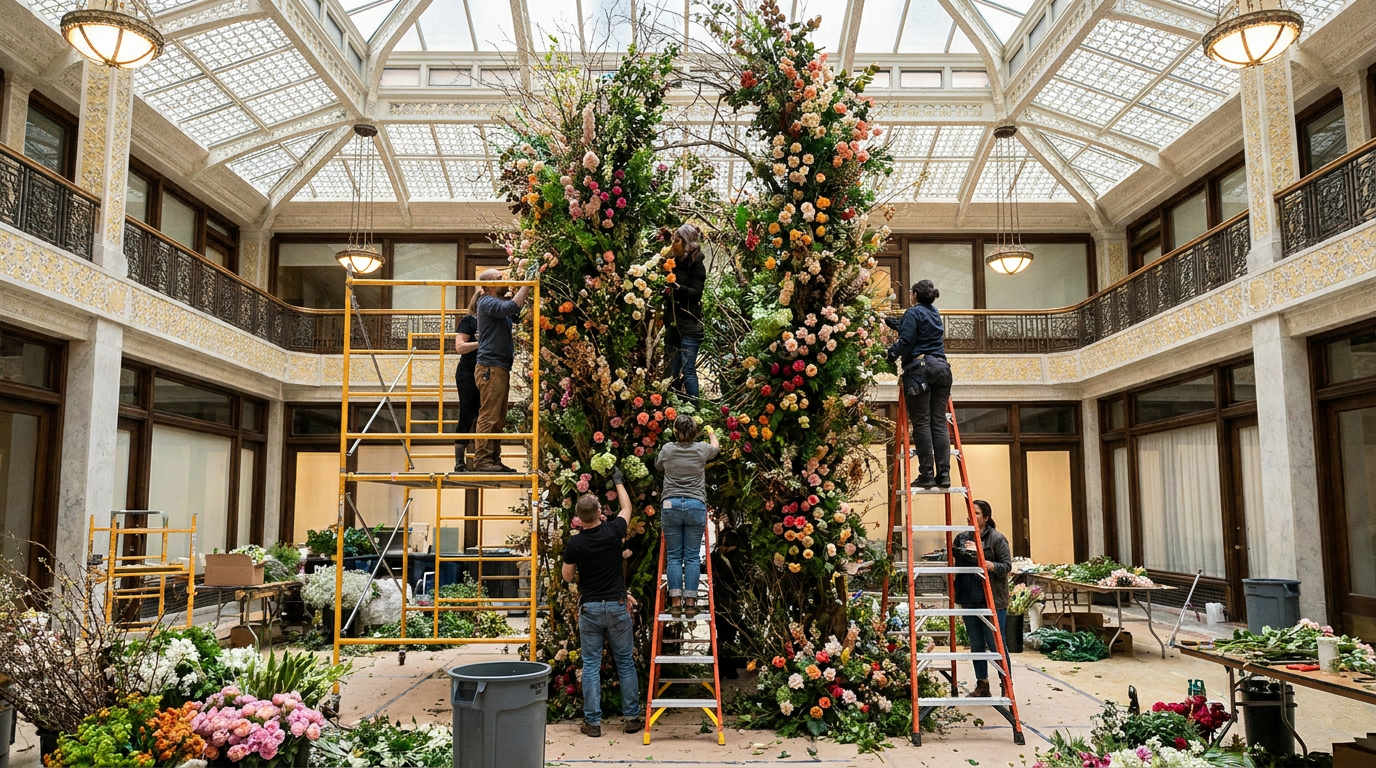
In a protected room we design freestanding, self supporting florals, and we confirm every detail in writing with the venue coordinator before anything is built.
Here is the honest answer about installation rules at landmark venues, and it is not the answer you will find elsewhere. Most of these buildings do not publish any.
Consider the evidence you can check yourself. The City of Chicago’s wedding information page for the Chicago Cultural Center publishes package pricing to the exact dollar, room capacities for both halls, a deposit percentage, and a firm midnight end time. It is remarkably transparent. It says nothing at all about what you may install. A building can be completely open about money and completely silent about structure.
So we design for the honest condition. Freestanding means the structure carries its own weight, stands on the floor, and leaves the building untouched. Nothing borrows the architecture for support.
This is where sculptural training stops being a nice biography line and starts being useful. When you cannot touch the building, the structure has to be engineered, balanced, and beautiful from every angle, because guests will walk all the way around it.
Vendor requirements are documented, and those we can state plainly. Cafe Brauer works from an approved vendor list through Lincoln Park Zoo, and vendors not on that list need advance approval and insurance, with Tigerlily as the exclusive in house caterer and beverage provider. The Chicago History Museum asks couples to select a caterer from its named approved list.
Every property is different, and the coordinator is the source of truth. We confirm before we design, which is also why a rendering from us is a promise we have already verified.
Once you know what can be built, the room tells you what color it should be.
What the Room Does to Color and Light
A room with its own strong color gives you two honest choices: harmonize with it, or contrast with it on purpose. Ignoring it is the only thing that never works.
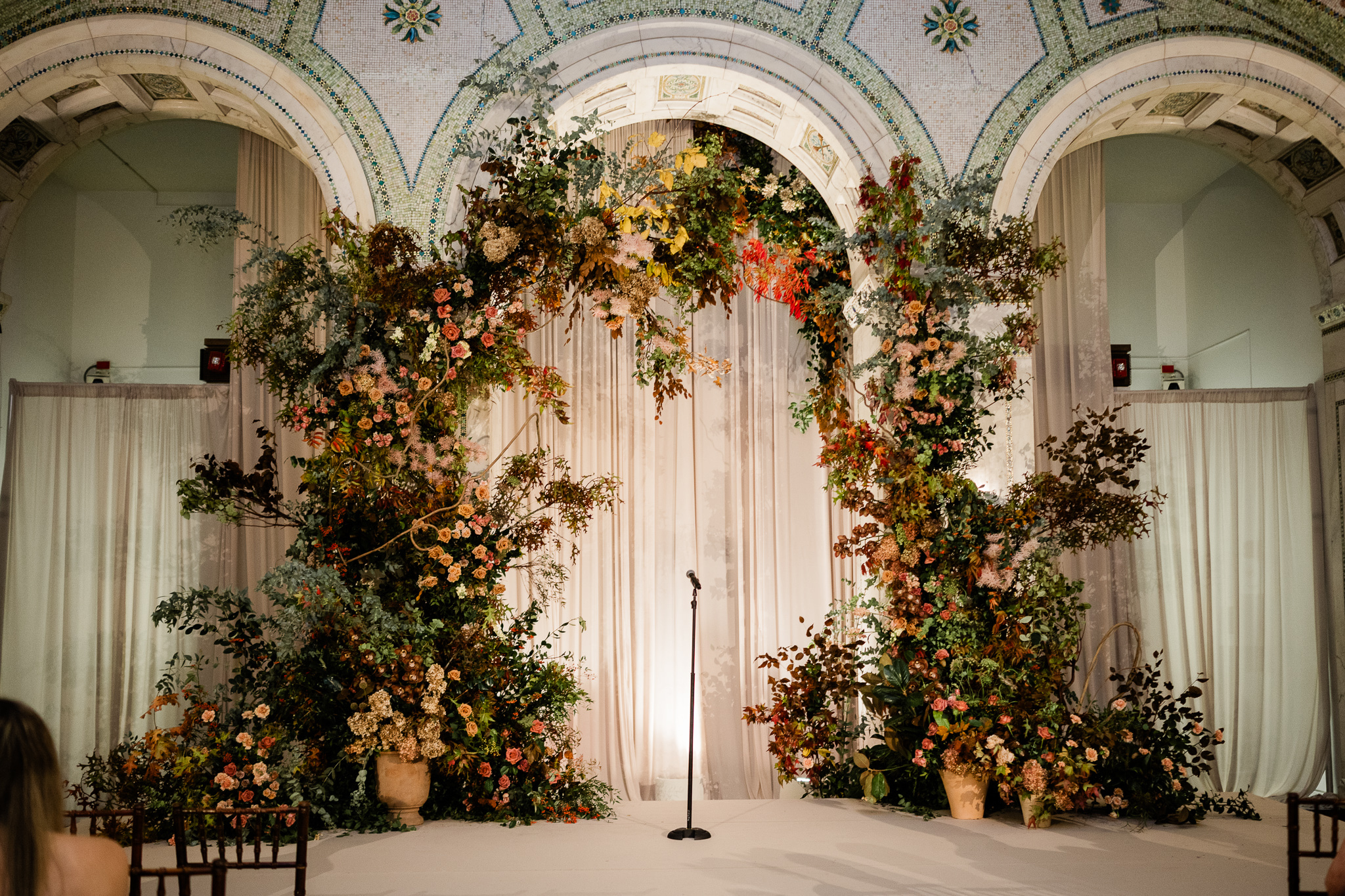
Chicago Cultural Center. Mosaic inlaid arches, marble, and two stained glass domes, including the world’s largest Tiffany dome and 25 Tiffany chandeliers spread across Preston Bradley Hall. Colored glass does something to light that photographs never quite prepare you for. It warms it and tints it. White flowers rarely read as true white under that ceiling. Ivory, cream, and warm blush hold their character beautifully. Cool blue whites tend to go slightly gray. If you want a Chicago Cultural Center wedding in a crisp modern palette, that is absolutely possible, but it has to be chosen deliberately and lit for, not assumed.
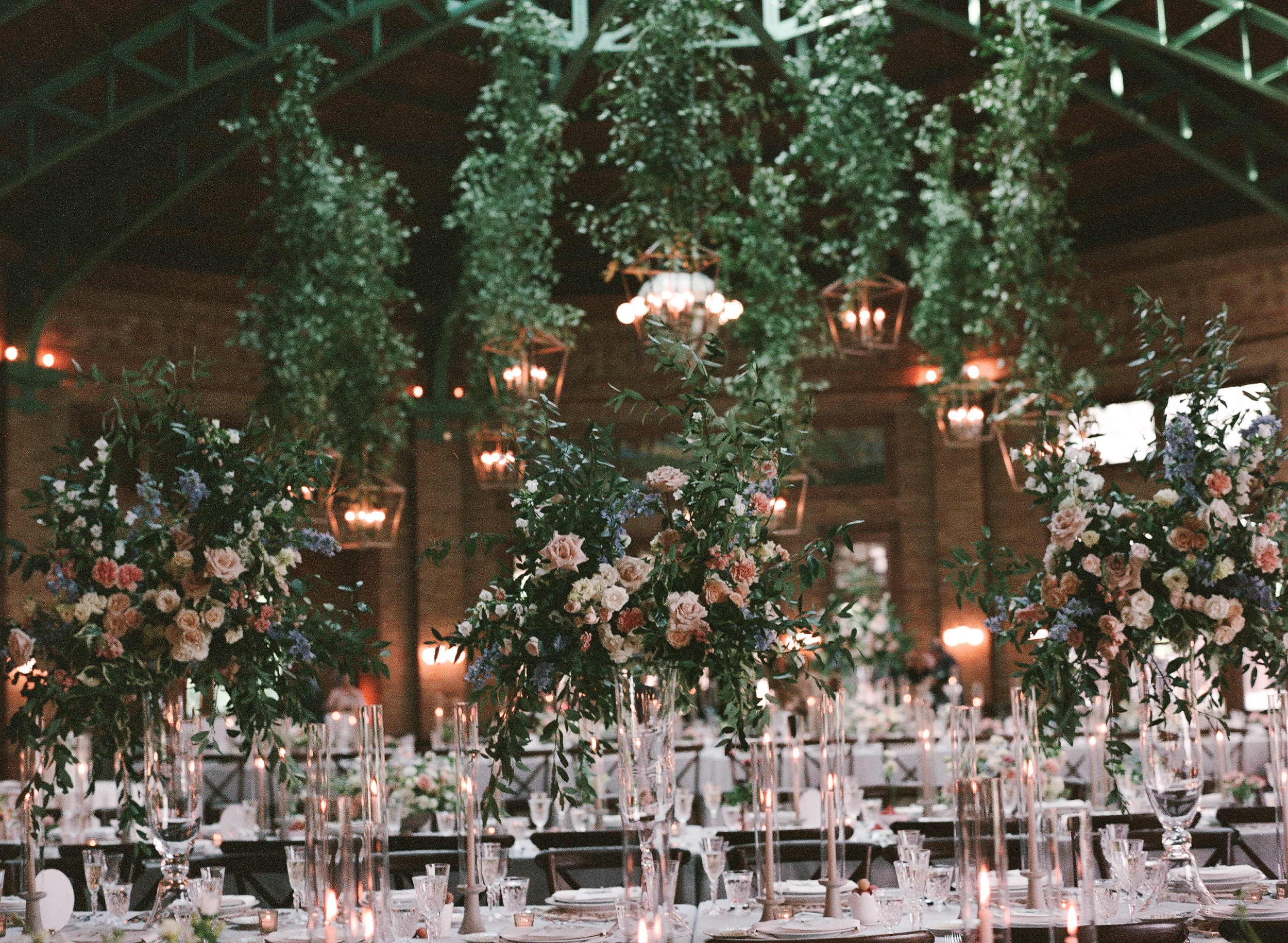
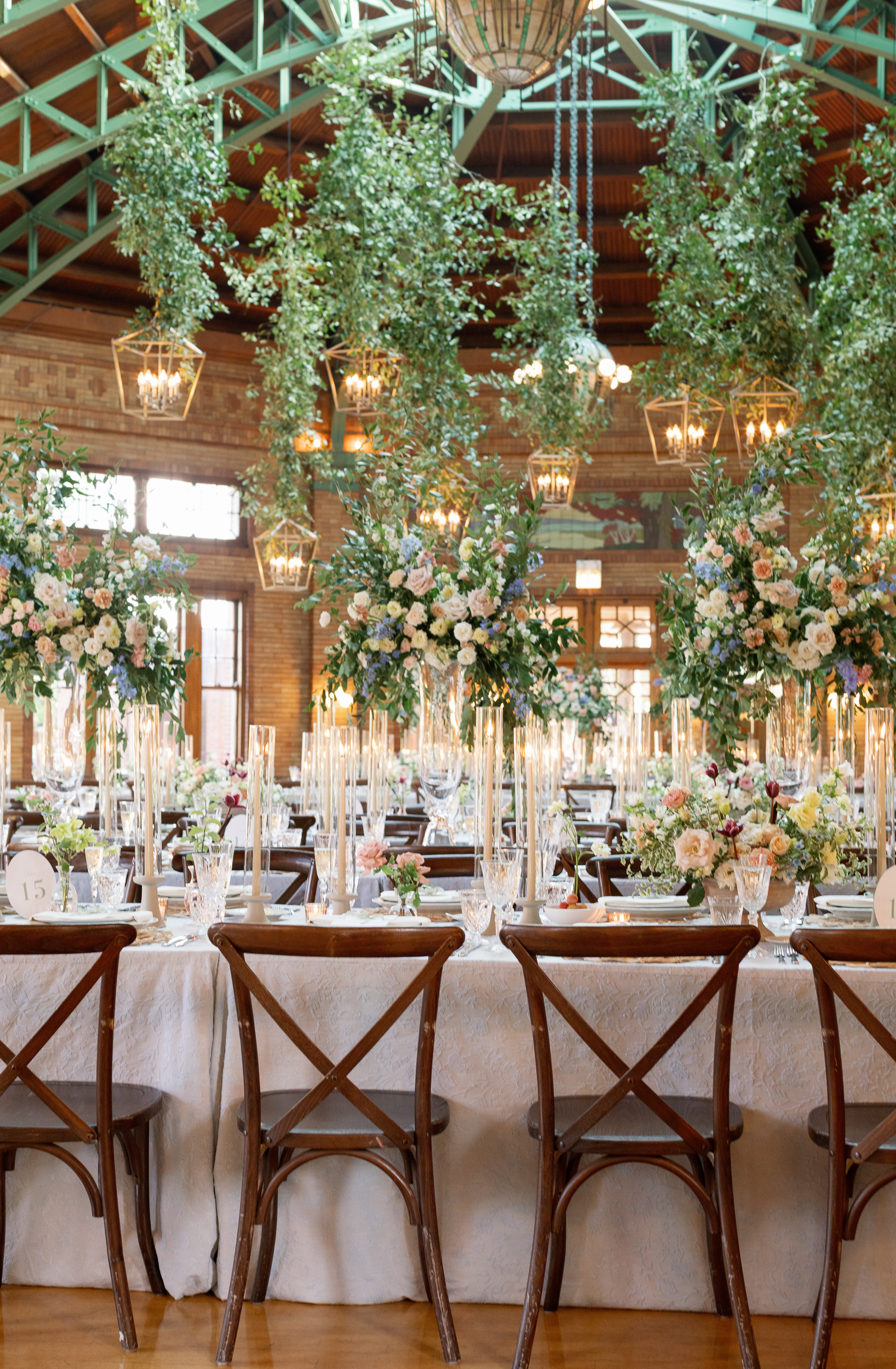
Cafe Brauer. Inside, the Prairie School woodwork sets a honeyed, golden base before a single stem arrives. Warm whites, cream, rust, and amber settle into that wood as though they grew there. Cool blues and stark whites fight it, and the wood always wins.
Chicago History Museum. Georgian architecture and tall windows, which means daylight is a real ingredient. A 10 a.m. wedding and a 6 p.m. wedding in the same room are genuinely two different designs. Morning light is clean and revealing. Evening light is yours to build.
The rule we give every couple is simple. Choose your palette after seeing the room at the hour of your event, not before. Photographs taken at noon in June will lie to you about an October evening.
This is also why we handle lighting and drapery alongside florals. The palette and the light falling on it get designed together, by one team, rather than by two vendors who never speak to each other.
All of this planning assumes one thing: enough time in the room.
Load In, Timing, and Access at Landmark Venues
At most protected venues the real limit is not space, it is how many hours you have to build.
The Chicago History Museum publishes its windows clearly. Evening weddings run 6 p.m. to midnight, a six hour window, and daytime rentals run 10 a.m. to 1:30 p.m. Rentals include a member of the special events staff on site from setup through breakdown, which is a genuine help to a design team rather than a formality.
For the Chicago Cultural Center, the City of Chicago publishes that the wedding package covers six hours of event time, that additional hours are $1,000 each, and that all events must end by midnight. The City also notes that a union electrician is only necessary if added power is required, with fees depending on what is needed and how long the electrician is on site. Since lighting is part of what we design, that is worth knowing in month one rather than month nine.
Here is what a short window means in practice. Pieces are built at our studio on West Grand Avenue and arrive nearly finished. Time in the room is assembly, not construction. Nobody should be problem solving inside a landmark building with the clock running.
A photorealistic 3D rendering earns its keep here. Scale, color, and placement are settled weeks before install day, so the crew arrives executing a decision instead of making one.
We also take a limited number of events each weekend. That is not a boutique affectation. It is what makes a demanding install window possible at all.
Every constraint named so far has a cost attached to it.
What a Historic Venue Does to Your Budget
In a historic room, more of the budget goes into building and moving structure, and less of it into stems alone.
Start with the venue itself. The City of Chicago publishes Chicago Cultural Center wedding package pricing at $14,550 for Preston Bradley Hall or GAR Hall and Rotunda, and $18,150 for both. Published fees change, so check the current page before you build a budget around them. Florals and decor are separate.
Couples consistently miss what that package already covers: six hours of event time, room rental, two off duty officers, building security, custodial services, standard department owned equipment, and a dance floor. There is no in house catering. The venue publishes a list of recommended caterers, and a caterer not on that list can be approved by providing the required license and insurance.
We are not publishing rental figures for Cafe Brauer or the Chicago History Museum, because we cannot verify them to the same standard. Go to each venue’s own page for those.
On the design side, the cost driver is straightforward once you say it out loud. If nothing attaches to the building, the structure has to be designed, built, transported, assembled, and removed. That is engineering and labor, not flowers. The second driver is the short install window, which usually means a larger crew working at once rather than a small crew working longer.
Our minimums are $40,000 from November through April and $50,000 from May through October. For the fuller picture, we wrote a complete guide to what wedding flowers cost in Chicago.
Knowing where the money goes early is what makes the rest of the process calm. Most couples arrive with the same handful of questions.
Frequently Asked Questions
How much does a Chicago Cultural Center wedding cost?
The City of Chicago publishes wedding packages at $14,550 for Preston Bradley Hall or GAR Hall and Rotunda, and $18,150 for both. Fees change, so check the current page. Florals and decor are separate.
What is included in the Chicago Cultural Center wedding package?
Six hours of event time, room rental, two off duty officers, building security, custodial services, standard department owned equipment, and a dance floor. There is no in house catering, and the venue publishes a recommended caterer list.
What time do events have to end at the Chicago Cultural Center?
All events must end by midnight. The package covers six hours of event time, and additional hours are $1,000 each per the City of Chicago.
How much setup time do we get for a Chicago History Museum wedding?
Evening weddings run 6 p.m. to midnight and daytime rentals run 10 a.m. to 1:30 p.m. A special events staff member is on site from setup through breakdown.
Can we use any florist for a Cafe Brauer wedding?
Cafe Brauer works from an approved vendor list, and vendors not on it need advance approval and insurance. Tigerlily is the exclusive in house caterer and beverage provider.
Can you hang or suspend flowers in a historic Chicago venue?
It depends on the building, and most landmark venues do not publish installation rules. We design freestanding pieces and confirm attachment and rigging in writing with the coordinator before any design is approved.
Is the Chicago Cultural Center the same as the South Shore Cultural Center?
No. They are two different buildings. The Chicago Cultural Center is at 78 E Washington Street in the Loop. The South Shore Cultural Center is a separate Chicago Park District property on the South Side.

Bring a Designer In Early
The architecture is published. The capacity is published. The rules almost never are. That is a reason to bring your designer in early, not a reason to avoid these rooms, because rooms like these are worth the extra conversation.
We take a limited number of events each weekend so every one of them gets built properly. Life In Bloom is a certified Women’s Business Enterprise, founded and owned by Rachel Wyffels.
Let’s build something unforgettable. Inquire now. Tell us your venue and your date, and we will tell you honestly what the room will let us do.
Inquire Now or View Our Portfolio.



COMMENTs:
0