

There is a specific hush that falls over a room right before a ceremony begins, when someone, inevitably, looks up. Above them, a cascade of garden roses and trailing greenery seems to float, glowing under the late afternoon light. At the center of it all, a couple stands beneath a floral chuppah so lush it looks like it grew there overnight.
These moments are also, quietly, some of the most technically demanding builds in event design. A suspended floral installation or a ceiling-anchored chuppah is only as beautiful as it is structurally sound. At Life In Bloom, the most breathtaking overhead moments are the ones where nobody in the room ever thinks about the engineering behind them, because it was handled with the same care as the florals.
This piece covers two categories: freestanding suspended installations, like ceiling florals and hanging gardens, and the floral chuppah, a structure with its own history and specific demands. We will also walk through five questions every couple and planner should ask a venue before a ceiling install is ever promised. Life In Bloom is a boutique, full-service design studio in Chicago’s West Loop, and we design these installations from first sketch through photorealistic 3D rendering to install day. See our wedding ceremony flowers page for how we approach overhead ceremony design, chuppahs included.

What a Suspended or Ceiling Installation Actually Requires
It is tempting to think of a ceiling installation as a floral project first. In practice, it is the opposite. The florals are the last five percent of a process that begins with questions about architecture, weight, and access.
Every suspended installation starts with a hard point, a structural anchor that is genuinely load-bearing, not simply the nearest ceiling tile or decorative beam. A drop ceiling grid might look sturdy, but it is almost never designed to support suspended weight. A true hard point might be a structural steel beam, a reinforced truss brought in for the event, or an architectural element the venue has already certified for hanging loads.
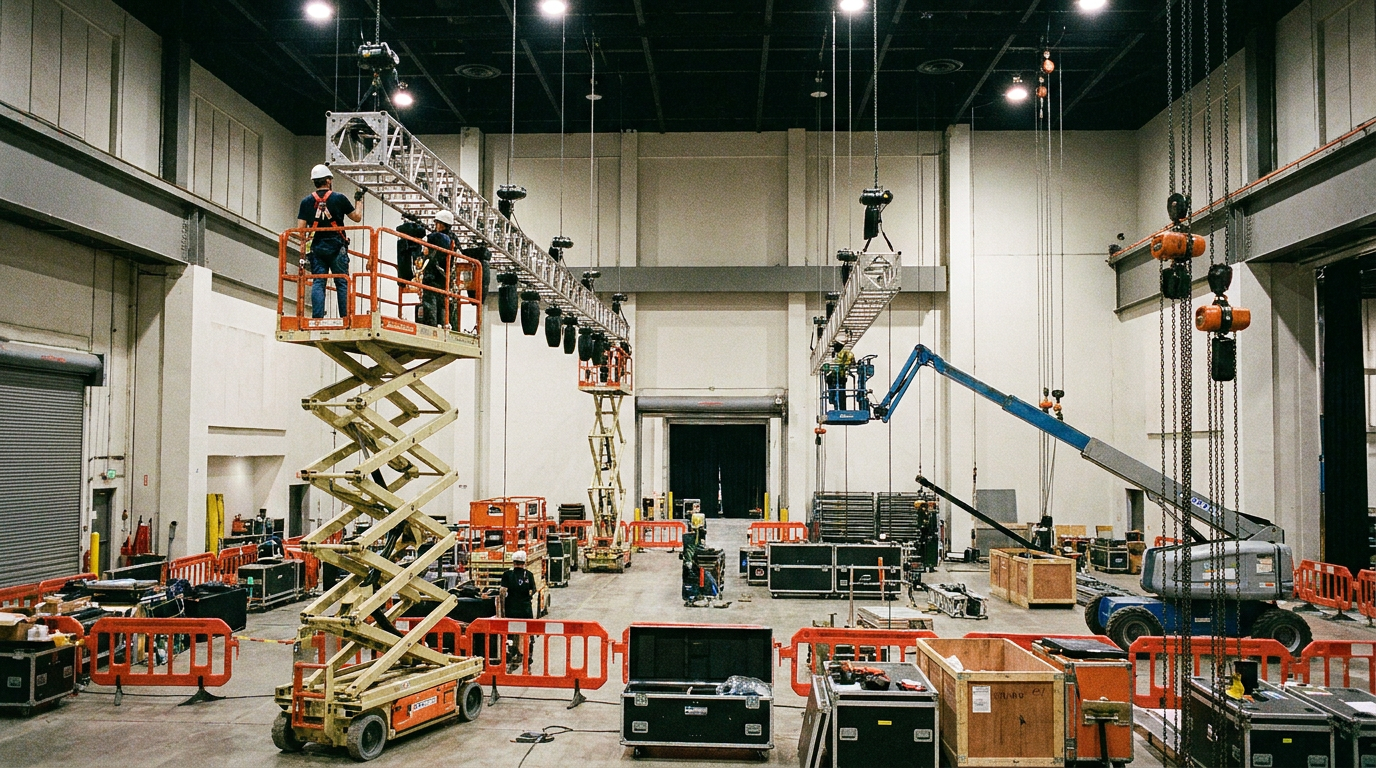
From there, the general sequence tends to follow a pattern: a rigging or support system bears the load first, whether a pipe-and-base frame, a truss, or motorized hardware. Only after that structural layer is confirmed does the floral work begin, often with hydration mechanisms, wire, and zip ties doing the quiet work of holding everything together.
Weight adds up fast once fresh florals, foliage, water sources, and mechanics are combined. A twenty-foot floral runner suspended over a dance floor, fully hydrated, can weigh far more than its visual lightness suggests. This is why experienced teams lean on engineering input rather than estimation.
Every venue brings its own engineering consequences. A historic ballroom with ornate plaster ceilings, like those in many of Chicago’s storied hotel venues, is a different challenge than a raw loft with exposed steel. Plaster is often decorative rather than structural, so hard points have to be found elsewhere. Raw industrial steel may be rigging-friendly but comes with its own height and access considerations.
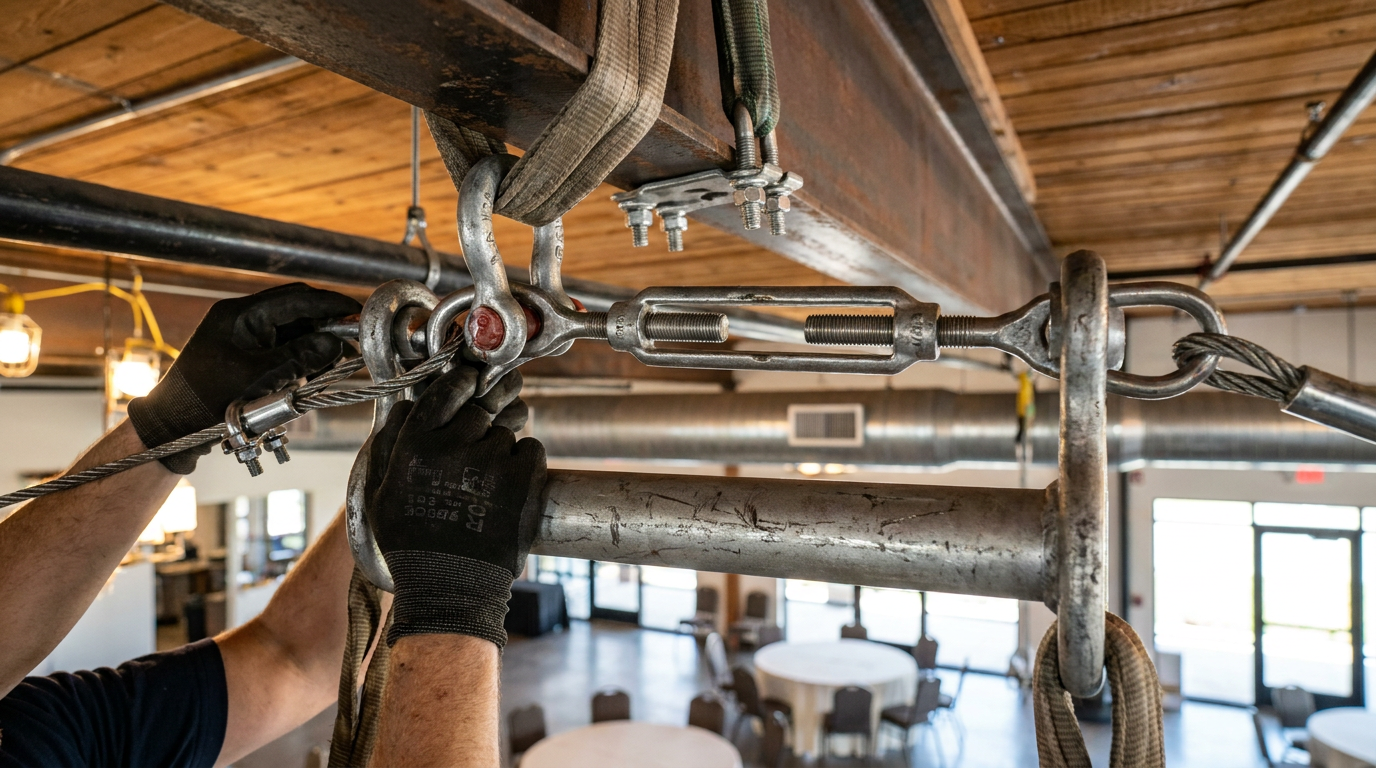
What ties this together is collaboration. A design team can imagine a spectacular floating garden, but that vision has to be tested against what the venue, and often a licensed rigger or structural engineer, confirms is possible.
The Floral Chuppah: Structure, Weight, and Materials
A chuppah is a four-post structure under which a Jewish couple is married, traditionally open on all sides, symbolizing the home the couple will build together. It is one of the most meaningful elements of a Jewish ceremony, and increasingly, one of the most photographed.
That symbolism is why so many couples want their chuppah to feel lush and unforgettable. But material and construction have real consequences for how it is engineered.
Natural birch poles are popular for their organic, textural look, though raw birch varies in weight and strength. Finished wood posts offer more structural consistency. Acrylic or lucite posts create a modern, nearly invisible structure, though they require their own engineering considerations. Metal frameworks, whether brass, iron, or powder-coated steel, tend to offer the most reliability for heavier canopy designs.
There are also two fundamentally different categories of chuppah construction. A free-standing chuppah has four posts, each with its own anchored base, supporting the structure independently of the ceiling. A suspended or ceiling-anchored canopy instead hangs from a confirmed hard point overhead. Both can be stunning, but they are engineered in completely different ways.
Then there is rental versus custom build:
- Rental: More budget-conscious and faster to plan, strong for couples who love a classic silhouette and want to invest more in the florals themselves.
- Custom build: Allows a fully bespoke silhouette and dimensions tailored to a venue, but requires more lead time and budget.
A floral-heavy chuppah, especially one with a fully draped canopy, carries far more weight than it appears to in photos. This is why the design and engineering conversation needs to happen early, well before flower varieties are finalized.

“A chuppah is one of the most meaningful structures in a wedding, which means it has to be as sound as it is beautiful.”
We have designed chuppahs from minimal, modern structures to fully immersive floral canopies for ceremonies across Chicago, New York, and Aspen. See our 15 Stunning Chuppahs for Jewish Weddings for that range in action.
Five Questions to Ask Any Venue Before a Ceiling Installation
These are questions a couple or planner should bring to a venue coordinator, not answers Life In Bloom provides on a venue’s behalf.
1. Where exactly is the hang point, and is it rated for suspended loads?
A venue coordinator should be able to point to a specific location already confirmed to bear weight.
2. What is the load rating, and who determined it?
This is a question for the venue or a licensed structural engineer, never an estimate.
3. Does the venue require proof of rigging insurance?
Many do, and it is easier to confirm weeks ahead than to discover the morning of install.
4. Does the installation require a licensed rigger, and does the venue have an approved vendor list?
Some venues mandate a specific rigging partner. Knowing this early prevents last-minute scrambling.
5. What are the restrictions on install and strike times, lift access, and ceiling type?
Plaster, drywall, exposed steel, and drop ceilings all behave differently and come with different access requirements.
Asking these five questions protects the couple, the venue, and the design team alike. These standards echo broader industry safety frameworks, including the event safety and rigging standards published by ESTA and ANSI through USITT.
How 3D Rendering Settles the Design First
Every Life In Bloom client sees a full, photorealistic rendering of their suspended installation before install day. Not a sketch, a rendering that shows scale, color, and placement within the real dimensions of the room.
This matters for suspended work specifically, since overhead installations are difficult to visualize from a swatch of greenery and a description. The rendering lets our team work through exactly where an installation will hang and how it interacts with lighting and table level florals, adjustments that are far easier to make on a screen than on install morning.
It also becomes a planning tool for the structural conversation. A venue coordinator reviewing a rendering understands what is being proposed. A rigger can start thinking through load paths with clarity about scale. This happens well before any lift or rigging equipment arrives on site, which is part of why we take on a limited number of events each weekend.


Frequently Asked Questions About Floral Chuppah Structures
Can any chuppah be suspended from the ceiling?
No. This depends entirely on the venue’s structural capacity at that location, and should always be confirmed with the venue and a qualified rigger.
What materials are floral chuppahs typically made from?
Natural birch, finished wood, acrylic or lucite, or metal framing, each changing the chuppah’s weight and visual style.
Is it better to rent or custom build a chuppah?
Renting is more budget-friendly and faster for classic silhouettes. Custom builds allow a fully bespoke design but need more lead time and budget.
Do venues require a licensed rigger for a floral chuppah installation?
Many do, particularly for ceiling-anchored canopies. Always confirm directly with the venue’s event team.
Does a floral chuppah need insurance coverage?
Rigging insurance is commonly requested by venues for any suspended structure, and should be part of vetting any installation vendor.


Bringing Structure and Beauty Together
Suspended florals and floral chuppahs are entirely achievable and genuinely stunning when the structural groundwork is treated with the same seriousness as the floral design. The magic was never improvisation. It was craftsmanship, planning, and trusted partnerships.
That is our philosophy at Life In Bloom: full-service design spanning florals, linens, lighting, and custom furniture, a 3D rendering process that removes guesswork, and a limited number of events each weekend so every detail gets the attention it deserves. We are proud to be a certified Women’s Business Enterprise and a founder-led studio in Chicago’s West Loop, now designing events across Chicago, New York, and Aspen.
When artistry and engineering are treated as one conversation, what guests remember is not the rigging or the load ratings. They remember looking up.
If you are ready to explore a suspended floral moment or a floral chuppah for your celebration, inquire now and let’s start building something unforgettable together. Our floral and decor minimums begin at $40,000 in the off season and $50,000 during peak season. If you are still in the early, dreaming stages, browse our portfolio or explore more of our blog for inspiration.



COMMENTs:
0