

Every trend list published this time of year is assembled from the same few hundred images. The 2027 wedding flower trends you have been reading about are mostly a record of what photographs well in a single frame. They tell you almost nothing about what couples are actually booking.
Here is the more useful question. What are couples sitting in a Chicago studio genuinely asking for right now?
This comes from a boutique studio that takes a deliberately limited number of events each weekend, in consultations happening this autumn for 2027 dates. Below is what is really being requested, including a substantial look at wedding color palettes, because that is where nearly every conversation begins.

Why Couples Ask About Wedding Flower Trends
Couples ask about wedding flower trends because they want reassurance that their wedding will feel current, not because they want a wedding that looks like everyone else’s. That distinction matters more than it sounds.
So we do not answer the question literally. A trend is a starting point for a conversation about your taste, your venue, and your season. It is not an order form. When someone arrives with twelve saved images, those images are telling us how they want the room to feel, which is the hardest thing for anyone to put into words.
The best weddings borrow a feeling from a trend rather than copying its execution. We listen to the vision first, then add fresh ideas on top of it. It is worth understanding what to expect from a luxury wedding florist before you sit down for a first consultation.
Almost every one of those consultations begins in the same place. Color.
Wedding Color Palettes for 2027: Where Every Consultation Starts
Wedding color palettes are the first real decision in almost every consultation, because color sets the emotional temperature of a room before a guest notices a single flower.
Here is the part no trend list covers. A palette is built in proportions, not in names. There is a base tone, which covers the most surface area and does most of the quiet work. There is a depth tone, which gives the room weight and keeps it from floating away. Then one or two accent tones, which appear in small doses and carry all the personality. Two couples can choose the same four colors and end up in completely different rooms depending on how much of each they use.

Something relevant just happened in the color world. Pantone named Cloud Dancer, a soft white, as its 2026 Color of the Year, the first white ever selected since the program began in 1999.
Practically, a neutral base year pushes all the interest somewhere else. When the base goes quiet, texture, shape, and accent have to carry the room. That is a harder design problem than a bold base, not an easier one.
The directions genuinely showing up for 2027 follow that logic. Warm neutrals and soft whites as a base. Deep earth tones for depth, meaning plum, fig, olive, and muted terracotta. Fruit toned brights used as accent, in small deliberate doses, rather than as the whole scheme.
There is an honest tension here. Vogue is reporting bolder, fruit toned color for 2026 and beyond, and Martha Stewart is calling a brighter direction heading into 2027. Meanwhile a great many couples walk in asking for something calm and neutral. Both things are true. The way a designer resolves it is almost always the same. Keep the base soft, and let the accent carry the boldness.
One Chicago specific warning. A palette chosen on a phone screen in March behaves very differently in a dark historic ballroom than it does in a glass walled room over the river. Test your colors in the room, at night, with the lighting you will actually have.
Once color is settled, the conversation moves to shape. That is where requests have changed most noticeably.
Shape, Structure, and Texture Are Changing Fastest
Couples are asking less often for one showpiece arrangement and more often for a room that feels designed from the ceiling down.
That means immersive and architectural florals. Suspended installations, ceiling treatments, and florals that read as part of the building rather than as objects placed on tables. Who What Wear has flagged immersive installation work as a defining 2027 direction, and it matches what we build.

The opposite request is happening at the same time. Lower, conversational arrangements. Clustered vessels with candlelight so guests can see each other across a table. These are not competing trends. They frequently appear in the same wedding, because the ceiling and the tabletop are doing different jobs.
Texture is winning over volume. Fewer flower varieties used more deliberately, with branches, dried elements, and fruit mixed in for contrast, a direction the Los Angeles Times has tracked in its floral trends reporting.
We treat these requests as construction problems as much as floral ones. Our Creative Director, Vince Phan, holds a master’s in sculptural arts, and we fabricate custom structures, bars, and backdrops in house. That matters because anything suspended is a heavy object hanging above seated guests. Rigging is a building by building question, and venues rarely publish the answer, so we put it in writing with your venue before we design anything overhead. We ask before we draw rather than after. Our designer’s guide to Chicago hotel wedding venues covers how that conversation tends to go.
Not everything circulating online survives contact with a real room.
What Is Rising, and What Is Only Circulating Online
There is a real gap between what gets saved on Pinterest and what couples commit to once they are standing in their venue.
Some ideas photograph beautifully in one frame and fall apart across a full room. Others work perfectly for one table and become exhausting at thirty. A single image is shot from the best angle in the best light with nobody sitting in the chairs. Your wedding does not get that treatment for five straight hours.
So apply four questions before you fall in love. Does it still work at scale, where one is a centerpiece and thirty is a build? Does it work in your venue’s light after dark? Does it hold up across an entire evening, since delicate materials have a shelf life measured in hours? And does it work from a seated guest’s eye level, given that most inspiration images are shot from above and nobody attends your wedding from above?
What genuinely holds up is consistent. Immersive design, texture led arrangements, and personal detail have staying power because they survive all four questions. What tends not to survive is anything whose entire appeal is novelty in a single photograph.
The press agrees on the underlying shift. Vogue’s reporting on personality led design describes generic, cookie cutter weddings falling out of favor and story led design rising. The weddings that still feel right in photographs years later are the ones that looked like the couple, not like the year.
None of this is a reason to stop saving images. Bring them. We would rather start from something you love than from a blank page. The test simply tells you which ones are a feeling to borrow and which ones are a plan to follow.
How Chicago Venues and Seasons Change the Answer
A trend is not a style. It is a decision that has to survive a specific room in a specific month.
Venue architecture drives the answer more than anything on a mood board. An ornate historic ballroom is already doing a great deal of visual work, so florals compete or they complement. An industrial loft has volume to fill and almost no detail to echo. A glass walled room with skyline views changes character completely between the toast and the last dance. A tent is a room you are building from nothing, which is its own discipline, covered in our designer’s guide to tented weddings.
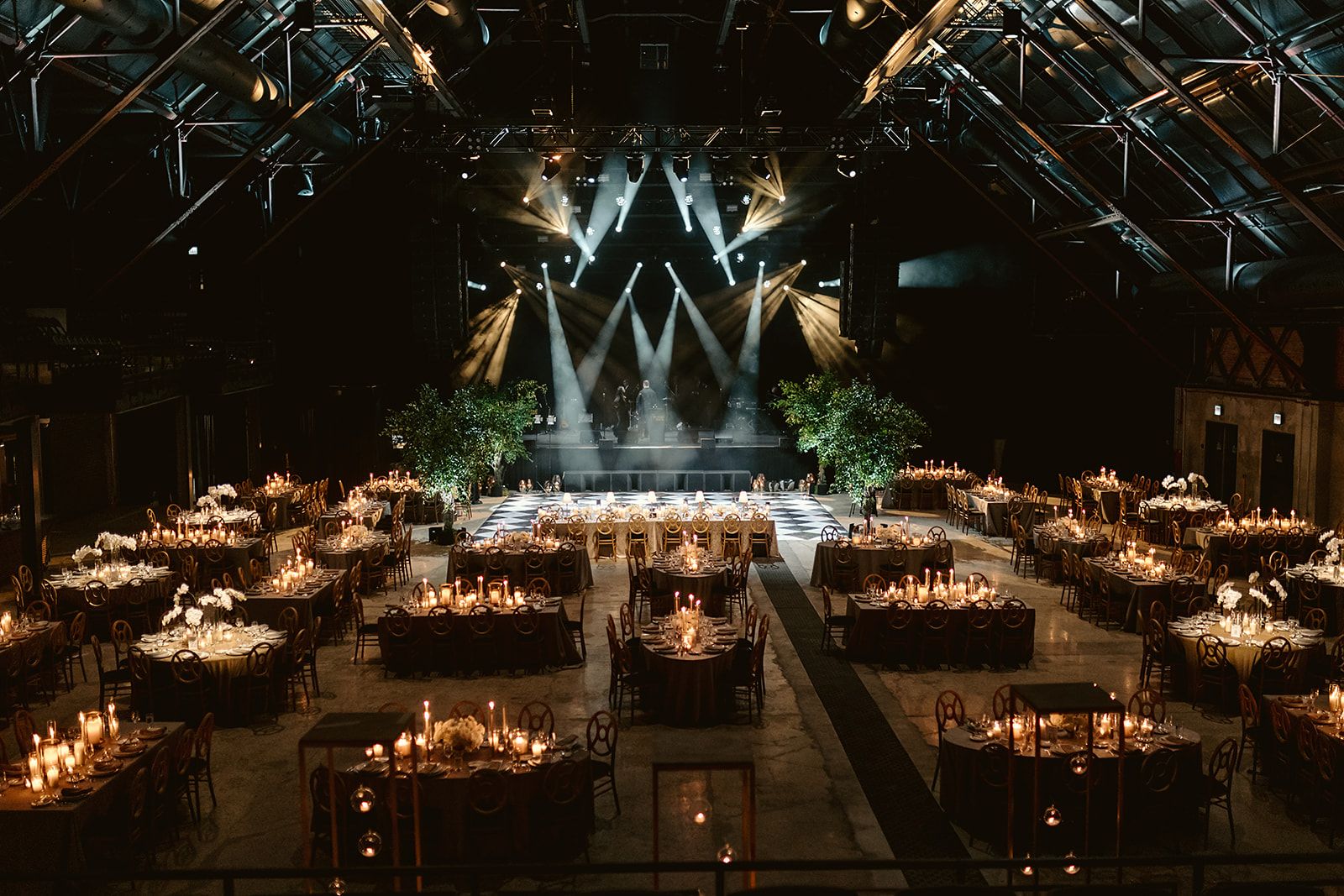
Season changes both what is available and what feels right. Flowers are grown, not manufactured, and a bloom has to exist in that color, at that size, in that volume, on your actual date. Chicago’s off season runs November through April, and winter is not a compromise. Deeper, moodier palettes and candlelight are genuinely better in February than in June. This February wedding at 167 Events proves it with a bold, colorful, moody direction against skyline windows.
That seasonality shapes cost, which is why our floral and decor minimums are $40,000 from November through April and $50,000 from May through October.
A palette that sings in a June garden can disappear entirely in a dark February ballroom. That is a design decision to make early, not a limitation to discover late.
Which raises a fair question. How do you know before you commit?
Seeing It First: Test a Trend Before You Commit
Every Life In Bloom client sees a photorealistic 3D rendering of their event before the day, which means a trend can be tested rather than gambled on.
You see the palette in your actual room, at your actual scale, with your actual table count. You find out whether the bold accent is right before a single stem is ordered.

We are also honest about the limits of a pretty picture. Every studio can produce a beautiful rendering now, which is why a beautiful rendering is only half the promise. What matters is whether the thing inside the image can actually be built, by the people showing it to you.
No guessing. No hoping.
2027 Wedding Flower Questions Couples Ask Most
What wedding color palettes are trending for 2027?
Soft neutral bases with deep earth tones for depth, meaning plum, fig, olive, and muted terracotta, plus restrained bright accents. Pantone naming a white, Cloud Dancer, as its 2026 Color of the Year is part of why bases are going quieter and texture, shape, and accent are carrying more of the room.
When should I book a Chicago wedding florist for a 2027 wedding?
Consultations for 2027 dates are happening now. Because we are a boutique studio that takes a deliberately limited number of events each weekend, dates are committed well in advance, particularly for peak season. If you have a venue and a date, that is the right moment to reach out.
What are the floral and decor minimums for a Life In Bloom wedding?
Our floral and decor minimums are $40,000 from November through April and $50,000 from May through October. Seasonality drives the difference, since availability changes across the year. For a fuller picture of budgeting, read our guide to how much wedding flowers cost in Chicago.
Do winter weddings in Chicago limit my flower choices?
No. Winter supports deeper palettes, generous candlelight, and dramatic texture in a way that summer genuinely does not. Chicago’s off season, November through April, is one of the most beautiful times to design here. It is a different set of choices, not a smaller one.
How do I know a trend will actually work in my venue?
You see it first. Every client receives a photorealistic 3D rendering of their design in their actual room, at actual scale, before anything is ordered. Our piece on the rendering process explains what separates a picture you love from one that can be built.

The Question Worth Asking Instead
The useful question was never what is trending. It was what is right for this couple, this room, and this season. The palettes and shapes worth borrowing are the ones that still look like you a year later, long after the year they belonged to has moved on.
Let’s build something unforgettable.
Tell us what you want the room to feel like, and we will show you exactly how it gets built. We take a limited number of events each weekend.



COMMENTs:
0